
High Power Foam Maker Comparison: Output, Power, and Portability
- Comparing Foam Output, Energy Demand, and Mobility Metrics
- Quantifying foam delivery: output units and testing protocols
- Electrical load and supply requirements
- Portability: weight, footprint, and deployment time
- Engineering Trade-offs: Performance, Efficiency, and Control Precision
- Pump and nozzle design impact on foam quality
- Foam liquids, concentration, and environmental considerations
- Control systems: manual vs wireless vs integrated automation
- Data-Driven Comparison: Output Classes and Typical Specifications
- Procurement Checklist and Operational Best Practices
- Site power, grounding, and safety compliance
- Maintenance, consumables forecasting, and lifecycle costs
- Logistics planning: transport, storage, and operator training
- Why Manufacturers and Buyers Prefer Certified Solutions
- Industry safety and interoperability references
- Verification: factory acceptance and site acceptance testing
- Why Siterui SFX Solutions for Large-Scale Foam Effects
- R&D, manufacturing, and quality assurance capabilities
- Customization, system integration, and deployment support
- Product portfolio and post-sale service
- Frequently Asked Questions
High-output foam generation systems require balanced consideration of foam volumetric yield, electrical demand, and on-site mobility; this guide synthesizes performance metrics, fluid economics, and operational constraints to help venue operators, rental houses, and production buyers select the optimal foam solution for clubs, arenas, and outdoor festivals while aligning with safety standards and integration requirements.
Comparing Foam Output, Energy Demand, and Mobility Metrics
Quantifying foam delivery: output units and testing protocols
Buyers should evaluate foam production using standardized volumetric or volumetric-equivalent metrics (liters/minute or cubic meters/hour) measured under nominal nozzle and pump settings with a fixed fluid concentration. Bench tests should replicate field duty cycles: continuous 10–15 minute bursts for club shows, and sustained operation for festival ramp-ups. Facility managers must request manufacturer test reports that state both peak and average foam output under defined head pressures and nozzle sizes.
Electrical load and supply requirements
Specification sheets must clearly list rated power consumption, inrush current, and recommended supply (single- or three-phase), plus required circuit protection. Large-scale generators often draw between 2 kW and 5 kW during continuous operation; some units with integrated compressors or heaters may exceed that during startup. Buyers should verify compatibility with venue distribution and coordinate with electricians to avoid nuisance tripping and voltage drop.
Portability: weight, footprint, and deployment time
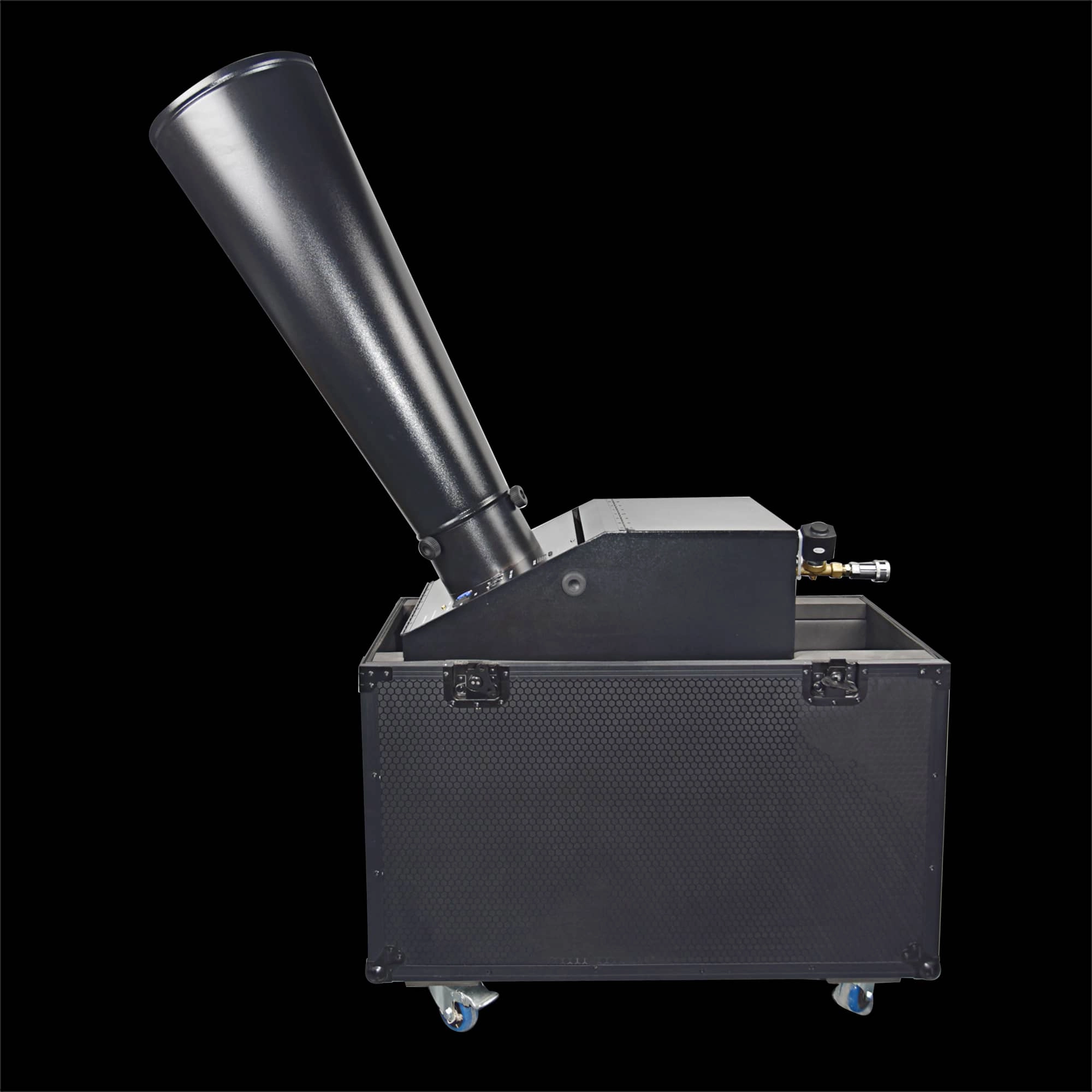
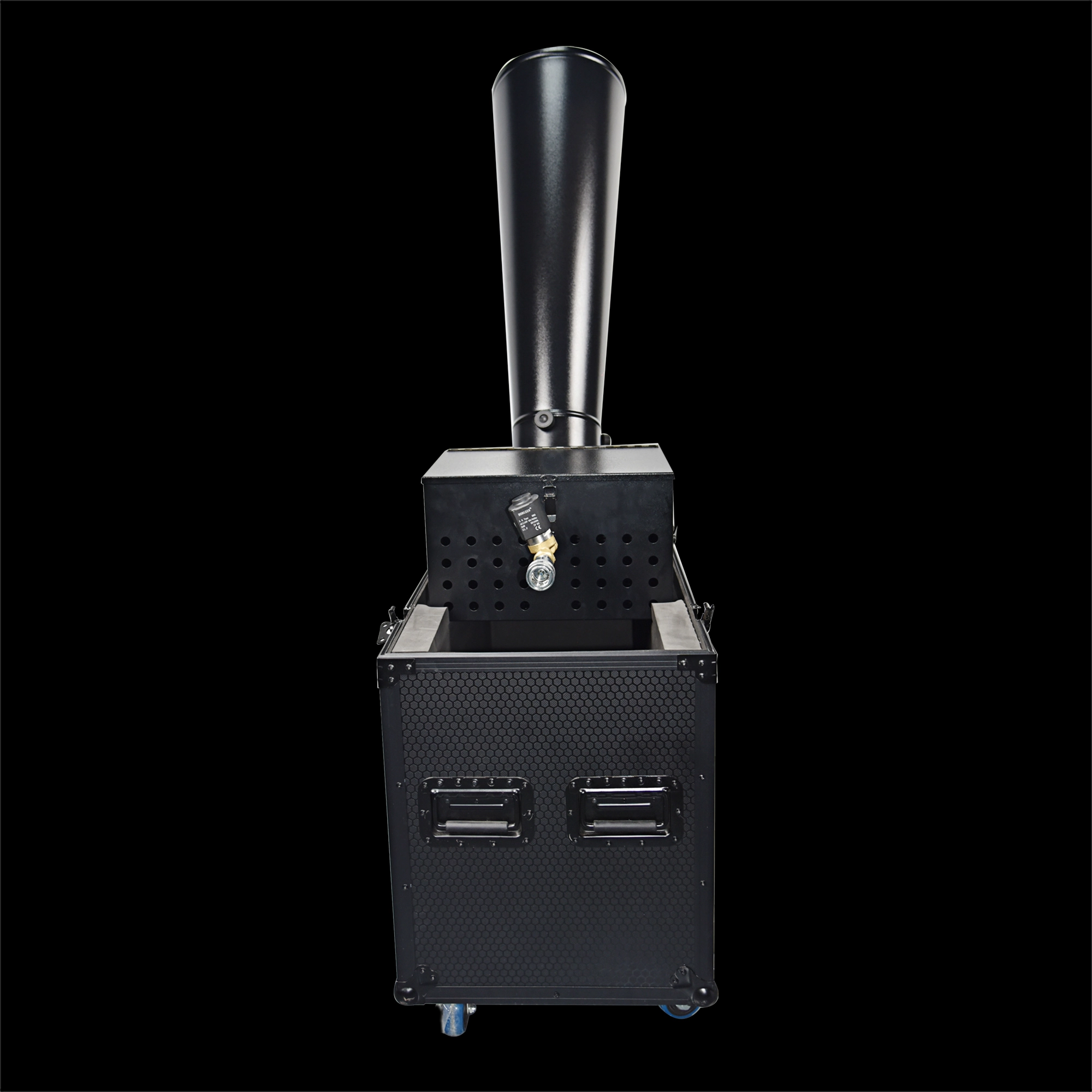
Portability is expressed through gross unit mass, wheelability, and system modularity. Lightweight units (under 20 kg) suit mobile DJs and compact stages, whereas high-output rigs (35–120+ kg) typically require road cases, fork or pallet handling, and 20–60 minute rigging time for placement, plumbing, and control integration. Logistics planning must include pack-out dimensions for transport vehicles and stage-level ingress constraints.
Engineering Trade-offs: Performance, Efficiency, and Control Precision
Pump and nozzle design impact on foam quality
Pumps, motor RPMs, and nozzle geometry determine bubble size distribution, foam density, and projection distance. Centrifugal pumps favor continuous high-volume delivery with lower maintenance, while positive-displacement pumps provide precise metering for dense foam production. Nozzle and aeration designs alter foam longevity on surfaces — select hardware that matches show goals (long-staying parade foam vs. quickly dissipating party foam).
Foam liquids, concentration, and environmental considerations
Fluid formulations influence foam expansion ratios and biodegradability. Buyers should request SDS documentation and water-compatibility certifications from suppliers; environmentally sensitive sites require low-toxicity, readily biodegradable chemistries that comply with local discharge rules. Estimating fluid consumption (liters per hour) under expected duty cycles is essential for budgeting and storage logistics.
Control systems: manual vs wireless vs integrated automation
Modern foam platforms offer multiple control paradigms: manual on/off, DMX/RDM integration for show control, and wireless RF triggers for mobile setups. For multi-device synchronized effects, confirm availability of master/slave or timecode sync and inquire about latency specifications for choreography with lighting and pyro. Integration-ready controllers reduce operator workload and improve repeatability across events.
Data-Driven Comparison: Output Classes and Typical Specifications
| Class | Typical Foam Output (L/min) | Power Consumption (W) | Fluid Use (L/hr) | Approx. Weight (kg) | Primary Venues |
|---|---|---|---|---|---|
| Compact / Portable | 50–200 | 300–800 | 1–5 | 8–20 | Mobile DJs, small clubs, pop-ups |
| Mid-Range Professional | 200–800 | 800–2,000 | 5–20 | 15–40 | Medium theaters, rental inventory, weddings |
| High-Output Arena/Outdoor | 800–3,000+ | 2,000–5,000+ | 20–100+ | 35–120+ | Concert arenas, large festivals, permanent installations |
Data above represents typical manufacturer ranges used by rental and production professionals; actual model specifications should be verified with certified test reports prior to procurement.
Procurement Checklist and Operational Best Practices
Site power, grounding, and safety compliance
Prior to purchase, specify voltage tolerances, circuit amperage, and whether three-phase feeds are available. Electrical safety and firecodes can vary; consult OSHA guidance for workplace electrical safety and local fire authorities for venue-specific required measures. For high-capacity installations, compliance with internationally recognized engineering practice such as ISO standards for equipment safety is recommended.
Maintenance, consumables forecasting, and lifecycle costs
Factor in foam fluid spend, filter and pump wear items, and scheduled servicing. A reliable service plan typically reduces downtime and saves replacement costs; ask suppliers for mean time between failures (MTBF) data and preventive maintenance intervals. Consider rental-house total-cost-of-ownership modeling that includes transport damage risk and consumable inventory turnover.
Logistics planning: transport, storage, and operator training
Confirm case dimensions for road trunks, verify operator SOPs for cold-start and warm-up cycles, and require supplier training or certified operator manuals. For large festival deployments, staging timelines should reserve time for system commissioning and a dry-run to validate synchronized control with lighting and audio cues.
Why Manufacturers and Buyers Prefer Certified Solutions
Industry safety and interoperability references
Special effects contribute to complex stage ecosystems; referencing authoritative industry resources can mitigate risk. For context on the broader discipline of theatrical effects and techniques, see Special effects. For engineering and technical standards bodies involved in electrical and systems interoperability, refer to IEEE publications and local regulatory agencies.
Verification: factory acceptance and site acceptance testing
Structured acceptance testing reduces installation issues. Request factory acceptance tests (FAT) and documented site acceptance tests (SAT) that include electrical load tests, foam output verification at defined nozzle settings, and control-system interoperability checks. Buyers should retain test records as part of warranty and compliance evidence.
Why Siterui SFX Solutions for Large-Scale Foam Effects
R&D, manufacturing, and quality assurance capabilities
As a professional manufacturer engaged in R&D, production, sales, and service of stage special effects equipment, Siterui SFX emphasizes design-for-serviceability and durable component selection. Our engineering team performs component-level stress testing and full-system endurance trials to validate continuous-duty performance for arena and festival environments.
Customization, system integration, and deployment support
We offer flexible customization—branding, bespoke enclosure sizes, and special functions such as variable expansion ratios and integrated heater modules—so systems align with venue constraints and creative intent. Wireless control options, DMX/RDM compatibility, and synchronized multi-device setups are available to minimize operator overhead and ensure repeatable show cues.
Product portfolio and post-sale service
Our range includes spark machines, haze machines, CO₂ jet devices, bubble systems, snow machines, foam platforms, confetti launchers, fog machines, flame effects, and dry ice units. We provide spare-parts kits, scheduled maintenance contracts, and rapid-response technical support. For specifications and local representation, visit https://www.siteruisfx.com/ or contact sales at sales01@strlighting.com for tailored quotations and FAT/SAT scheduling.
Contact the Siterui SFX sales team to discuss system sizing, on-site integration, and turnkey deployment options that match expected foam throughput and venue constraints.
Frequently Asked Questions
What metrics should be used to compare foam generator output?
Compare foam delivery using volumetric metrics such as liters per minute or cubic meters per hour, measured under controlled nozzle and pump settings; request both peak and average output values and a manufacturer test protocol for repeatability.
How do power requirements vary between compact and high-output foam systems?
Compact, portable units commonly draw 300–800 W, while mid-range professional systems often require 800–2,000 W and arena-class generators can demand 2,000–5,000 W or more; verify inrush current, phase (single- or three-phase), and venue distribution prior to purchase.
What is the typical fluid consumption and how should buyers budget for it?
Fluid consumption depends on expansion ratio and duty cycle; typical ranges are 1–5 L/hr for compact units, 5–20 L/hr for mid-range, and 20–100+ L/hr for high-output rigs. Buyers should model hourly consumption against expected event schedules and include storage and transport for bulk fluids.
Which safety and compliance resources are recommended for venue installations?
How important is control-system integration for foam effects?
Control-system integration (DMX/RDM, wireless triggers, or timecode) is critical for synchronized cues with lighting and pyrotechnics; integrated control reduces operator error and enables repeatable effects across shows, therefore buyers should confirm latency, channel count, and compatibility before procurement.

Email: sales01@strlighting.com
WhatsApp: +86 189 2232 4800
© 2025 Siterui SFX All Rights Reserved.
 Scan QR Code
Whatsapp: +8618922324800
siteruisfx_stage_equipment
Siterui
SITERUI-SFX
STRlighting
@siterui.sfx