
How to Choose the Best Low Fog Machine for Your Venue
Selecting the right low-lying fog system for a venue requires balancing effect quality, safety, air-handling impact, integration capability, and total cost of ownership; this guide breaks down types of ground-hugging smoke generators, technical selection criteria, regulatory and operational constraints, and procurement checklists to help buyers and facility managers specify the optimal stage low fog equipment for theatres, arenas, and live-event sites.
- Types of Ground-Hugging Fog Systems and Their Use Cases
- Dry ice foggers and cryogenic low-lying systems
- Chilled fluid foggers and glycol-cooled solutions
- CO₂ blade and jet-based ground effects
- Technical Selection Criteria for Venue Installations
- Effect characteristics: density, persistence, and drift
- Integration with lighting, automation and control systems
- HVAC interaction, air quality and occupancy limits
- Operational Risk Management, Certification, and Maintenance
- Regulatory compliance and industry standards
- Testing, commissioning and venue acceptance
- Serviceability, spare parts and training
- Procurement Checklist and Total Cost of Ownership
- Capital vs. rental decision logic
- Consumables, energy use and lifecycle costs
- Vendor evaluation and contractual protections
- Siterui SFX: Manufacturer Capabilities and How Suppliers Add Value
- Engineering, customization and system integration
- Product portfolio and complementary effects
- Quality control, certifications and after-sales
- Deployment examples and support model
- Buying Checklist: Minimum Requirements to Include in RFPs
- Technical data sheet and FAT criteria
- Safety documentation and insurance considerations
- Warranty, spare parts list and lead times
- Frequently Asked Questions
Selecting the right low-lying fog system for a venue requires balancing effect quality, safety, air-handling impact, integration capability, and total cost of ownership; this guide breaks down types of ground-hugging smoke generators, technical selection criteria, regulatory and operational constraints, and procurement checklists to help buyers and facility managers specify the optimal stage low fog equipment for theatres, arenas, and live-event sites.
Types of Ground-Hugging Fog Systems and Their Use Cases
Dry ice foggers and cryogenic low-lying systems
Dry ice-based generators create theatrical plumes by sublimating solid CO₂ into cold vapor that hugs the floor. These units are favored for short, dense ground effects in photo shoots, TV studios, and intimate theatre runs. Procurement considerations include CO₂ handling protocols, local storage for dry ice, and CO₂ monitoring in enclosed venues to avoid asphyxiation risks.
Chilled fluid foggers and glycol-cooled solutions
Chilled glycol or glycol-water mixtures passed through heat exchangers produce long-lasting, slow-moving fog blankets. These systems are commonly specified when continuous low-lying coverage and precise layer control are required. Buyers should evaluate refrigeration capacity, maintenance intervals for heat exchangers, and fluid compatibility with venue HVAC systems.
CO₂ blade and jet-based ground effects
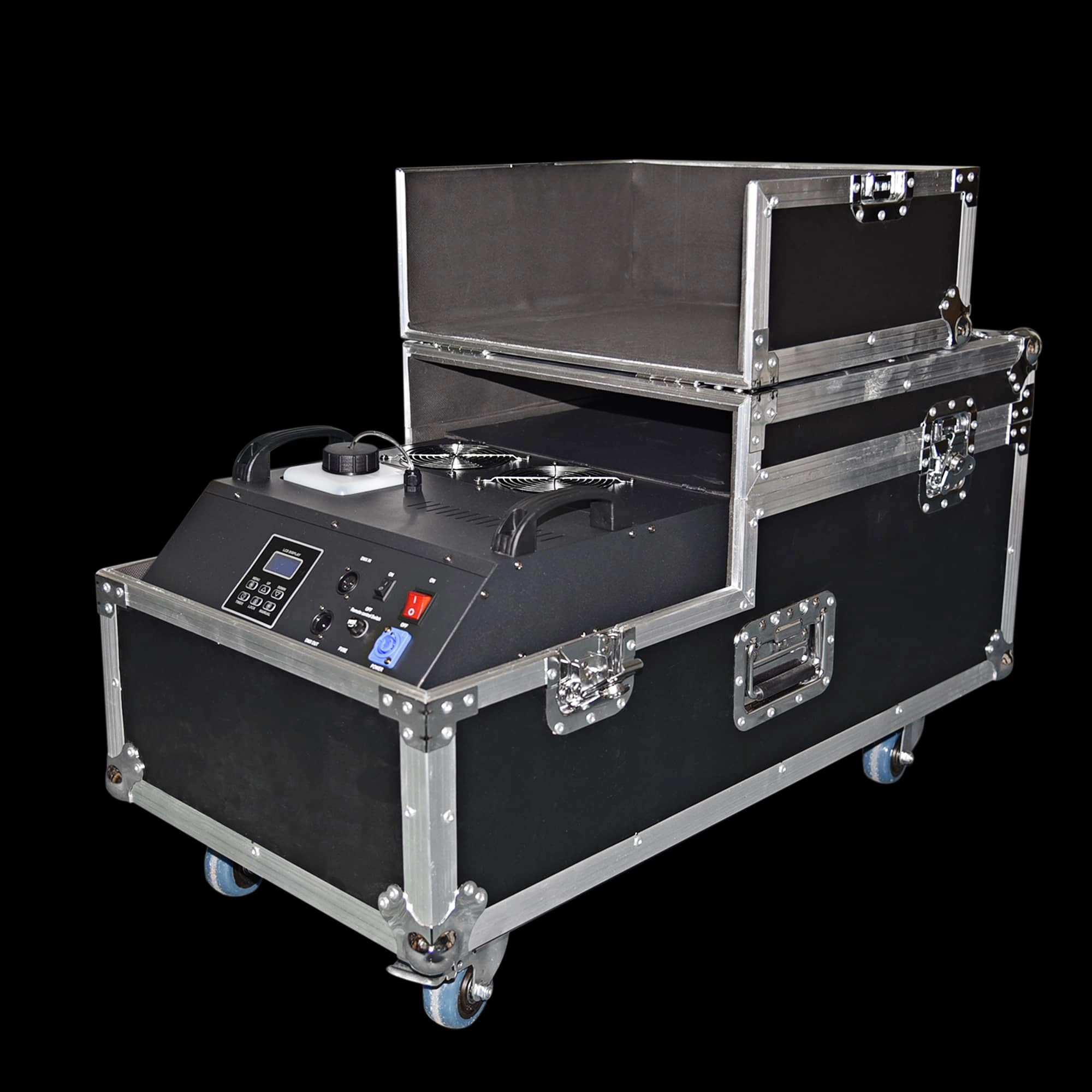
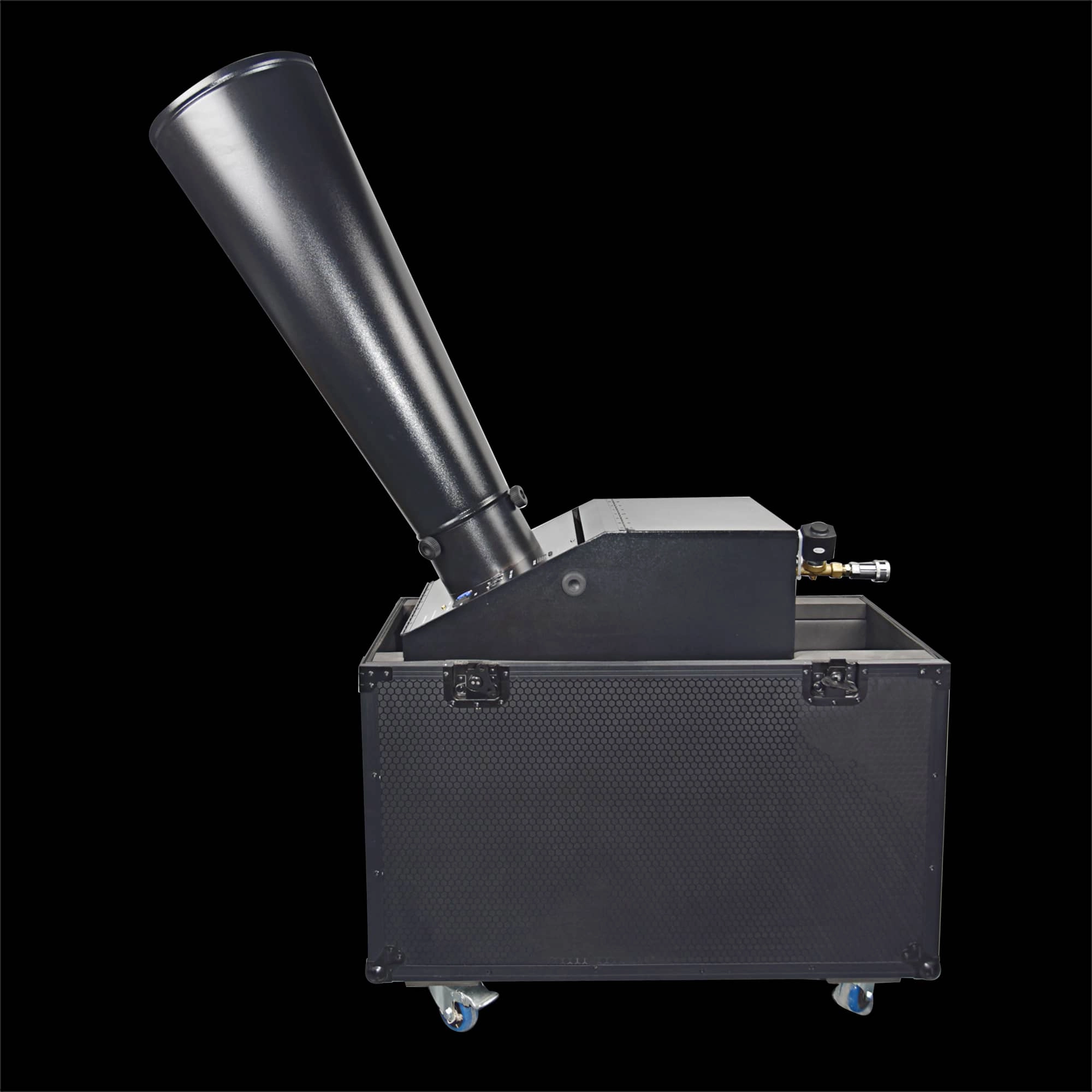
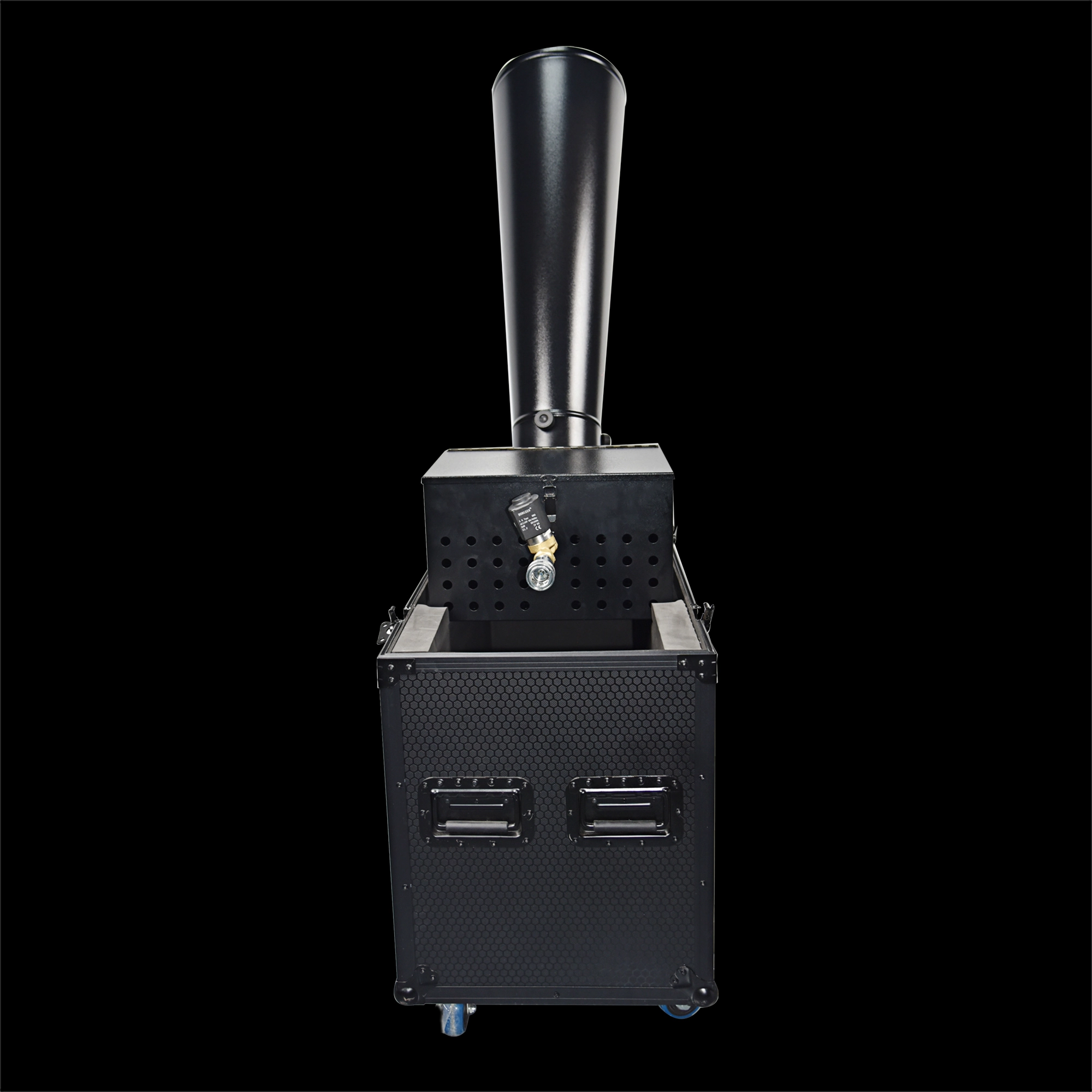
High-pressure CO₂ jets and blade systems deliver short bursts of floor-level fog that are visually dramatic for concerts and sports events. While effective for synchronised cues, CO₂ jets require careful deployment planning for audience safety, sufficient ventilation, and regulatory compliance concerning compressed gas equipment.
Technical Selection Criteria for Venue Installations
Effect characteristics: density, persistence, and drift
Define the required visual profile: a thin low veil for dramatic lighting or a dense blanket for scene concealment. Dense blankets often require colder, heavier vapor or chilled displacement approaches; persistent layers need continuous fluid or cryogen replenishment and a designed flow pattern to avoid unwanted vertical lift.
Integration with lighting, automation and control systems
Confirm DMX/RDM, Art-Net, or proprietary remote-control compatibility to enable precise synchronization with lighting and pyrotechnic cues. For multi-device arrays, ensure control topology supports grouped triggering, status feedback, and failover logic so that the effects network behaves predictably during live shows.
HVAC interaction, air quality and occupancy limits
Assess the venue’s air-handling capacity and the impact of ground-hugging effluents on smoke detectors, sprinklers, and indoor air quality. Coordinate with mechanical engineers to model dispersion paths and CO₂ concentration under worst-case scenarios; for guidance on occupational safety and ventilation, consult OSHA.
Operational Risk Management, Certification, and Maintenance
Regulatory compliance and industry standards
Confirm that selected apparatus and consumables adhere to applicable safety and quality standards. ISO certification for manufacturers can indicate quality management systems; buyers can reference ISO guidelines for supplier evaluation. For fire-safety coordination and pyrotechnic interfaces, consult standards and guidance from NFPA.
Testing, commissioning and venue acceptance
Project acceptance should include staged commissioning with venue technical teams: detector sensitivity tests, HVAC interaction runs, and occupant-exposure assessments. Create a commissioning checklist with measurable pass/fail criteria—e.g., maximum particulate counts, CO₂ ppm thresholds, and smoke-alarm immunity under normal operating sequences.
Serviceability, spare parts and training
Factor in Mean Time Between Failures (MTBF) data, spare-parts lead times, and availability of certified service technicians. Insist on operator training, written maintenance procedures, and a documented spare-parts kit to minimize downtime during touring or seasonal peaks.
Procurement Checklist and Total Cost of Ownership
Capital vs. rental decision logic
Estimate utilization frequency, transport and storage logistics, and customization needs. For perennial installations, capital procurement with integrated system design and warranty support often yields lower long-term cost. For one-off events or touring productions, rental or staging houses may be more economic when factoring transport and storage overhead.
Consumables, energy use and lifecycle costs
Quantify ongoing costs: fluid consumption for heated or chilled systems, CO₂ or dry ice replenishment, electrical load for heaters/refrigeration, and periodic refrigerant servicing. A lifecycle cost model should include replacement fans, pumps, heat-exchanger servicing, and end-of-life disposal compliant with local environmental regulations.
Vendor evaluation and contractual protections
Require documented factory acceptance tests (FAT), on-site installation tests (SAT), and warranty SLAs that specify response times and parts coverage. Include clauses for performance guarantees (e.g., minimum coverage area and layer persistence) and penalties if delivered systems fail to meet agreed visual or safety benchmarks.
| System Type | Primary Medium | Typical Effect | Key Safety Considerations | Best For |
|---|---|---|---|---|
| Dry Ice Fogger | Solid CO₂ (dry ice) | Cold, dense floor-hugging blanket | CO₂ accumulation; handling cold solids; ventilation | Short cues, controlled studio/theatre spaces |
| Chilled Fluid Low-Fog | Glycol-water or proprietary fluid | Long-lasting, low drift blanket with smooth edges | Fluid compatibility, refrigeration maintenance, spill management | Continuous effects for theatrical runs and film sets |
| CO₂ Jet / Compressed Gas | High-pressure CO₂ | Instant, powerful ground-level bursts | Compressed-gas safety, rapid CO₂ dispersion concerns | Concerts, sports entrance effects |
| Heated Glycol Fog | Glycol-based fog fluid | Visible fog that tends to rise (not ideal for floor-hugging) | Detector activation; particle inhalation sensibilities | General atmosphere and haze for lighting |
Siterui SFX: Manufacturer Capabilities and How Suppliers Add Value
Engineering, customization and system integration
Siterui SFX is a professional manufacturer engaged in research, development, production, sales, and service of professional stage special effects. Our engineering team evaluates venue blueprints, HVAC schematics, and control architectures to design low-lying fog installations that minimize interference with detection systems while delivering consistent visual performance. Customization options include bespoke casing, logo printing, variable-output pumps, and chilled-loop modifications to meet unique design briefs.
Product portfolio and complementary effects
Buyers should consider bundled effects to expand creative possibilities. Our product line integrates with complementary devices such as spark machine, Haze Machine, CO₂ Jet Machine, Bubble Machine, Snow Machine, Foam Machine, Confetti Machine, fog machine, fire machine, and dry ice machine. Bundling reduces integration costs, simplifies controls, and provides a single contractual path for support and spare parts.
Quality control, certifications and after-sales
Our manufacturing follows documented quality-management processes. Buyers often request supplier evidence such as factory test reports and component traceability. For guidance on reputable manufacturing standards, the industry often references third-party bodies; see documentation and accreditation frameworks at Wikipedia – Fog machine and official standards directories such as ISO. For fire and event-safety coordination, consult NFPA and occupational safety resources like OSHA.
Deployment examples and support model
Our typical deployments include theatre retrofits where the facility’s existing HVAC and detection systems are modelled, touring rigs with modular low-fog pods designed for quick rigging, and broadcast installations with redundant chilled loops for continuous operation. We provide operator training, installation supervision, and optional annual service contracts to keep systems within performance tolerances.
Buying Checklist: Minimum Requirements to Include in RFPs
Technical data sheet and FAT criteria
Require vendor submissions to include Electrical Load, Fluid Type, Output Curve (g/min), Coverage Area at X mm depth, Refrigeration BTU or CO₂ consumption per minute, and control interfaces. Specify factory acceptance test steps and acceptable tolerances for visual density.
Safety documentation and insurance considerations
Vendors must supply Risk Assessments, COSHH-equivalent documents for fog fluids where applicable, and Certificates of Conformity for gas-handling components. Confirm that installed systems align with venue insurance requirements and municipal permits for theatrical effects.
Warranty, spare parts list and lead times
Define warranty duration, parts excluded, and expected lead times for critical spares such as pumps, compressors, or refrigeration components to avoid extended outages during peak seasons.
For detailed specifications, demonstrations, or to discuss a customized low-lying fog system tailored to a specific venue, contact the Siterui SFX sales team or request product documentation.
Frequently Asked Questions
What are the main types of low-lying fog systems and how do they differ?
The primary categories include dry ice (solid CO₂) foggers that create dense, cold blankets; chilled-fluid low-fog systems using glycol or proprietary fluids for sustained floor-hugging effects; CO₂ jet systems that deliver instant bursts; and heated glycol fog which tends to rise. Each has different handling, ventilation, and maintenance requirements described in the procurement checklist.
How should venue HVAC and smoke detectors be evaluated before installing a floor-hugging fog system?
Venues should model dispersion paths and run commissioning tests with technical teams to evaluate detector immunity and CO₂ or particulate concentrations. Coordination with mechanical engineers and reference to occupational safety guidance (e.g., OSHA) helps define safe operating envelopes and acceptable occupancy conditions.
What safety certifications and documentation should buyers require from manufacturers?
Buyers should request factory test reports, Certificates of Conformity, documented quality management evidence (such as ISO registration), COSHH-like material safety data for fluids, and detailed risk assessments. For fire-safety coordination, referencing NFPA standards and local authority requirements is recommended.
Is it better to rent or purchase low-fog equipment for an organization?
The decision depends on utilization frequency, need for customization, storage and transport logistics, and total lifecycle cost. Permanent installations typically favor purchase for lower long-term costs and integration, while one-off events or tours may economically justify rentals.
What ongoing costs and maintenance should be budgeted for after installation?
Budget for consumables (fog fluids, dry ice, CO₂), energy costs for heaters/refrigeration, periodic refrigeration servicing, spare-parts replacement (pumps, fans, heat-exchanger elements), and annual safety inspections. Also include operator training and possible software/firmware updates in lifecycle costs.

Email: sales01@strlighting.com
WhatsApp: +86 189 2232 4800
© 2025 Siterui SFX All Rights Reserved.
 Scan QR Code
Whatsapp: +8618922324800
siteruisfx_stage_equipment
Siterui
SITERUI-SFX
STRlighting
@siterui.sfx