
Integrating DMX Foggers with Stage Lighting and Lasers
Integrating DMX-controllable ground-hugging vapor systems with stage lighting and laser displays requires coordinated signal mapping, safety interlocks, and venue-compliant environmental management; this guide outlines DMX addressing strategies, synchronization methods (MIDI/OSC/timecode), fluid and thermal considerations, ventilation and laser-safety compliance, and procurement criteria that buyers and technical directors must evaluate to ensure reliable low-level fog effects without compromising lighting contrast or laser safety. Practical system architectures, duty-cycle planning, maintenance protocols, and real-world performance metrics are included to aid specification, vendor selection, and on-site commissioning.
- System architecture and control strategies for programmable ground fog
- DMX addressing and channel allocation best practices
- Synchronization with lighting consoles and timecode systems
- Control redundancy and fail-safe design
- Optical interaction: maximizing beam definition with low-level vapors and laser shows
- Particle size, fluid chemistry, and optical scattering
- Laser classification, interlocks, and co-location safety
- Lighting contrast and color temperature considerations
- Operational safety, venue compliance, and environmental controls
- Regulatory compliance and venue insurance requirements
- Ventilation, HVAC interaction, and air-quality management
- Maintenance cycles, consumable management, and lifecycle costs
- Procurement checklist, integration testing, and acceptance criteria
- Technical specification template for bids
- Commissioning and on-site acceptance tests
- Comparison of common fog and haze approaches
- Why supplier capability and customization matter: selecting the right manufacturing partner
- Technical support, training, and spare-parts availability
- Customization options to fit installation constraints
- Warranty, testing, and quality assurance
- Siterui SFX: Manufacturer capabilities, product fit, and project support
- Company strengths and manufacturing competence
- Relevant products and integration-ready solutions
- Project services: customization, testing, and commissioning
- Contact and procurement support
- Frequently Asked Questions
Integrating DMX-controllable ground-hugging vapor systems with stage lighting and laser displays requires coordinated signal mapping, safety interlocks, and venue-compliant environmental management; this guide outlines DMX addressing strategies, synchronization methods (MIDI/OSC/timecode), fluid and thermal considerations, ventilation and laser-safety compliance, and procurement criteria that buyers and technical directors must evaluate to ensure reliable low-level fog effects without compromising lighting contrast or laser safety. Practical system architectures, duty-cycle planning, maintenance protocols, and real-world performance metrics are included to aid specification, vendor selection, and on-site commissioning.
System architecture and control strategies for programmable ground fog
DMX addressing and channel allocation best practices
When integrating a DMX-enabled ground fogger into a lighting rig, designers should reserve contiguous channel blocks for fog density, fan speed, heater control, and auxiliary triggers (strobe, pump prime). Typical profiles allocate 4–8 channels per device, depending on whether the unit exposes proportional heater output or binary on/off functions. To avoid bus contention, map fog control on a dedicated universe where possible, or implement RDM (Remote Device Management) to query device states. Many lighting consoles support channel macros—using these reduces programming time and improves repeatability during cue stacks.
Synchronization with lighting consoles and timecode systems
Precise timing between vapor output and lighting cues preserves beam definition and enhances volumetric effects. Synchronize fog devices using LTC or MIDI timecode where the console can drive pumps and heaters ahead of cue execution to compensate for output lag. For laser sequences, pre-triggering the fog generator by several hundred milliseconds to several seconds (dependent on particle settling behavior) ensures consistent visibility. Wireless DMX can be used for mobility, but wired DMX remains preferred for latency-sensitive shows.
Control redundancy and fail-safe design
Specifying a fog system for large venues requires redundancy planning: dual control paths (primary console plus local manual panel), emergency stop integration, and configurable output limits for quick isolation. A reliable system should provide configurable temperature/humidity cutoffs and error reporting via RDM or Ethernet for centralized monitoring. Buyers should request device-level event logs and telemetry to support root-cause analysis after incidents.
Optical interaction: maximizing beam definition with low-level vapors and laser shows
Particle size, fluid chemistry, and optical scattering
Beam clarity depends on aerosol particle size distribution and refractive index of the fog medium. Low-temperature, water-based fogs produce larger droplets with short residence times, while glycol or glycerin-based fog fluids form smaller particles that scatter laser light more uniformly. For tight beam shafts and laser rasterization, select fluids and generators that produce consistent micrometer-scale aerosols; consult manufacturers for measured particle-size curves and visibility distance under specified environmental conditions.
Laser classification, interlocks, and co-location safety
Combining high-power laser sources with volumetric fog requires strict adherence to laser safety standards such as ANSI Z136 series (Laser Institute of America). Implement hardware interlocks that disable laser emission if fog density exceeds safe thresholds or if ventilation fails. Facility owners should coordinate with safety officers and obtain an optical hazard analysis (OHA) before public operation. Many venues stipulate maximum permissible exposure (MPE) zones that must be respected when deploying scattering media near audiences.
Lighting contrast and color temperature considerations
Low-lying vapor affects white balance and contrast. To maintain color fidelity and beam punch, program key lighting cues with higher contrast ratios when fog layers are active, or use directional fixtures with shutters and gobos to shape illumination. Cross-fade strategies and incremental fog modulation can avoid washout of saturated colors and preserve laser color separation during multi-source shows.
Operational safety, venue compliance, and environmental controls
Regulatory compliance and venue insurance requirements
Operators must verify local fire codes and venue policies before using stage fog. Reference materials include NFPA guidance on pyrotechnics and special effects and workplace safety frameworks from OSHA. Some venues require product data sheets, MSDS for fluids, and proof of inspection for electrical and gas-powered systems. Insurance underwriters often mandate documented ventilation plans and emergency procedures for dense fog deployments.
Ventilation, HVAC interaction, and air-quality management
Low-lying fog tends to pool near floors; coordinate with venue HVAC to prevent unintended accumulation in aisles or near air intakes. Specify localized extraction or boundary fans where necessary and implement CO2 and particulate monitoring if CO2-based jets or dry ice systems are used. Continuously logging environmental parameters during events supports post-event compliance verification and reduces liability.
Maintenance cycles, consumable management, and lifecycle costs
Procurement should account for consumables (fluids, filters), wearable parts (pumps, heating elements, fans), and service intervals. Specify MTBF targets and Mean Time To Repair (MTTR) in contracts. Compare duty-cycle ratings and onboard reservoir capacities to match expected run times between refills. Lifecycle cost modelling often shows that higher-capacity, serviceable units reduce total cost of ownership for touring productions and fixed installations.
Procurement checklist, integration testing, and acceptance criteria
Technical specification template for bids
Request proposals that include: DMX channel maps, RDM compatibility, IP rating, power draw and inrush current, fluid compatibility matrix, measured output in cubic meters per minute, warm-up and cool-down times, noise levels (dBA at 1 m), and available certifications (CE, RoHS). Require load-in testing and a factory acceptance test (FAT) report demonstrating consistent output across environmental conditions similar to the venue.
Commissioning and on-site acceptance tests
Acceptance tests should validate: DMX responsiveness and latency, synchronization with console cues and timecode, achievable contrast distances for beams and lasers, thermal stability under continuous operation, and failure-mode responses to power loss and blocked outlets. Record results and include them in the final handover documentation.
Comparison of common fog and haze approaches
| Technology | Typical Visibility Effect | Control Compatibility | Safety/Operational Notes |
|---|---|---|---|
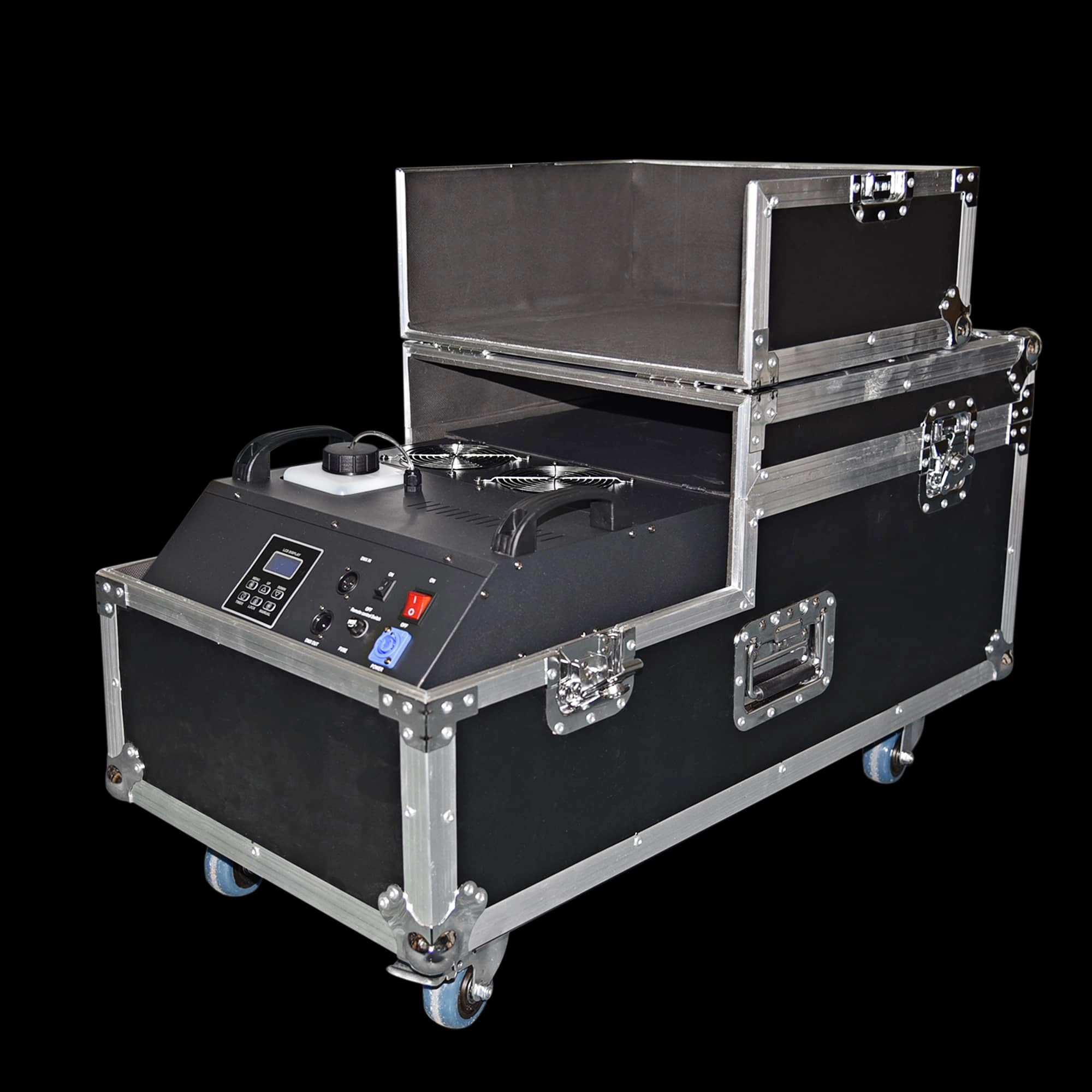
| Glycol/glycerin low-lying generators | Long-lasting low-level blanket; dense ground cover | DMX/RDM; proportional control available | Requires fluid maintenance; good for laser scattering; ventilation advised |
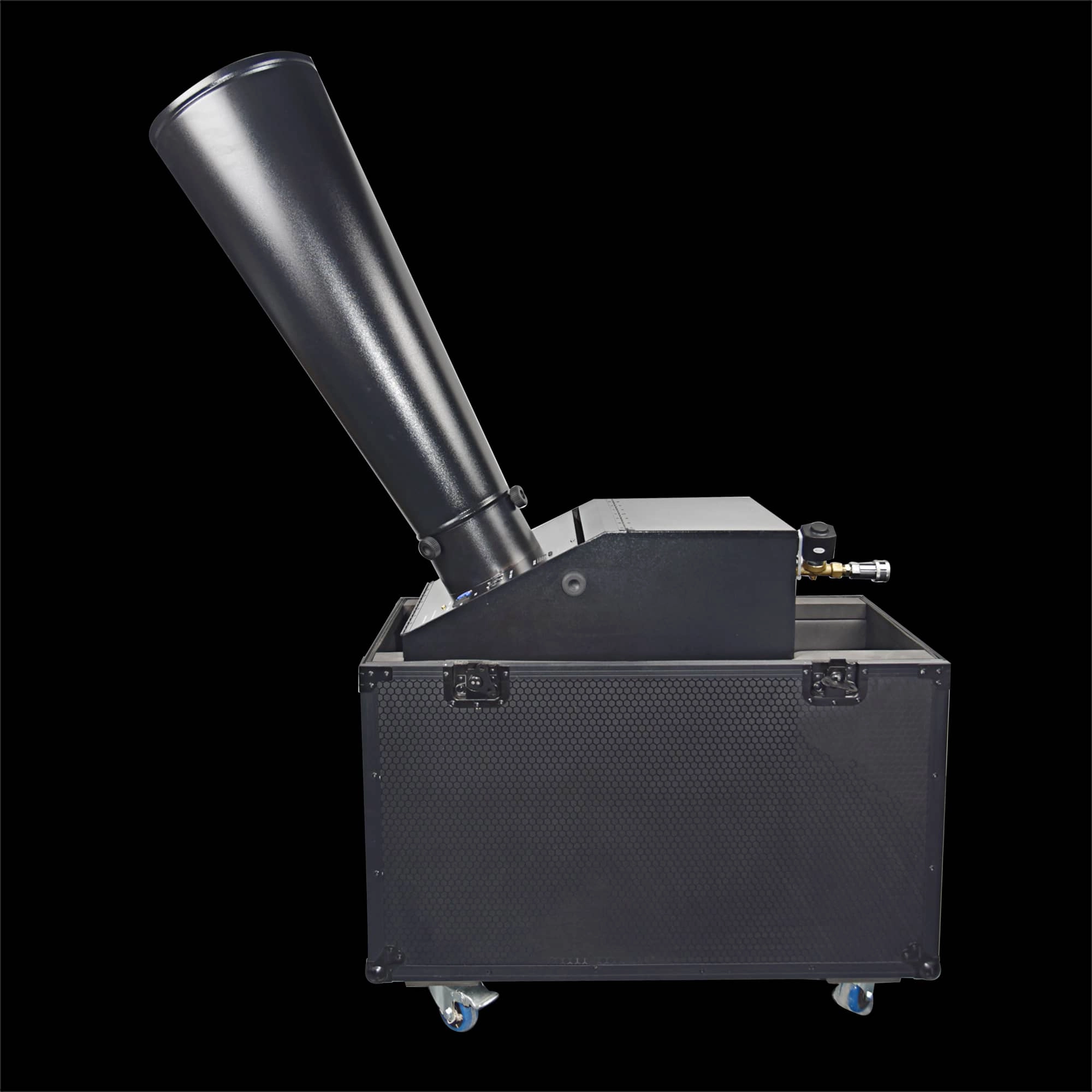
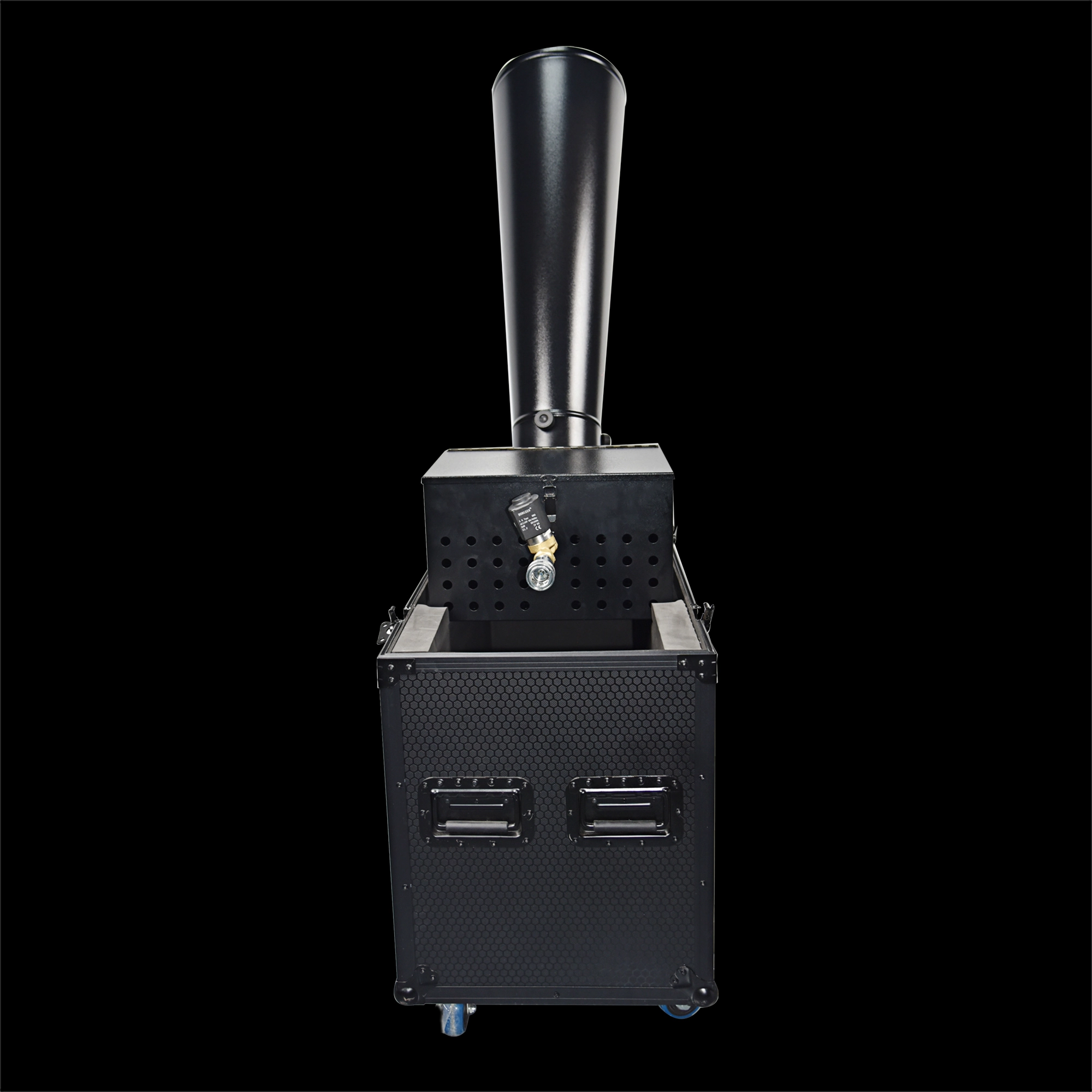
| Dry ice (CO₂) fog systems | Very cold, dense, immediate low-lying effect; short persistence | Often manual or solenoid-controlled; modern units offer DMX | CO₂ monitoring needed; not ideal for extended runs due to safety |
| Heated fog machines (water/glycol) | Higher plume; faster dissipation; good for beam shafts | DMX-enabled models available | Requires warm-up; avoid overheating; fluid residue considerations |
| Haze generators | Fine, persistent haze for uniform beam definition | DMX control common; steady-state operation | Low fluid consumption; suitable for continuous laser shows |
Why supplier capability and customization matter: selecting the right manufacturing partner
Technical support, training, and spare-parts availability
Buyers should select vendors who provide detailed commissioning support, operator training, and guaranteed spare-part inventory. For touring shows, quick access to replacement pump assemblies and control modules minimizes downtime. Preference should be given to suppliers offering global service networks and remote-diagnostics features to reduce mean time to resolution.
Customization options to fit installation constraints
Every stage and installation presents unique constraints. Look for manufacturers that offer custom casing, logo printing, bespoke control mappings, wireless control integration, and modified reservoir sizes. Customized airflow accessories (skirts, ramps, diffusion plates) help shape the low-lying layer to fit scenic designs without introducing airflow turbulence.
Warranty, testing, and quality assurance
Require clear warranty terms and factory test certificates. Insist on burn-in testing, thermal imaging reports for electrical components, and clear firmware versioning policies. Devices should include serviceable components and accessible maintenance panels to extend operational life and simplify field repairs.
Siterui SFX: Manufacturer capabilities, product fit, and project support
Company strengths and manufacturing competence
Siterui SFX is a professional manufacturer engaged in the research and development, production, sales, and service of professional stage special effects equipment. Our engineering team emphasizes modular, serviceable designs and strict quality-control processes to ensure reliability in touring and fixed-install environments. Buyers benefit from our global logistics and dedicated after-sales network to support multi-venue deployments.
Relevant products and integration-ready solutions
We offer a comprehensive portfolio including spark machines, haze generators, CO₂ jet units, bubble and snow systems, foam and confetti machines, traditional fog units, theatrical fire effect devices, and dry ice fog solutions. Each product can be configured with DMX/RDM or Ethernet-based control and is compatible with industry-standard consoles. Customization services include branding, wireless control modules, and synchronized multi-device cueing for complex productions.
Project services: customization, testing, and commissioning
Our manufacturing process supports flexible customization — from firmware channel maps to enclosure modifications and bespoke fluid reservoirs. We provide factory acceptance testing, on-site commissioning, operator training, and documentation packages to meet venue and insurer requirements. For laser-integrated shows, our teams collaborate with safety consultants to implement required interlocks and produce compliance documentation.
Contact and procurement support
Buyers and technical producers can request specification sheets, MTBF data, and sample test reports. For procurement queries, capacity planning, or customization requests, contact our sales team directly via sales01@strlighting.com or visit https://www.siteruisfx.com/ for product listings and case studies.
Frequently Asked Questions
Can DMX-controlled low-level foggers be synchronized with lighting consoles and laser timelines?
Yes. Synchronization is typically achieved using DMX cues combined with timecode (LTC/MIDI) or console macros; pre-triggering fog output compensates for generator latency and particle settling to ensure consistent beam visibility when laser or lighting cues execute.
What safety standards should be considered when combining fog effects with lasers?
Combining volumetric media and lasers requires compliance with laser safety standards such as the ANSI Z136 series and venue-specific policies; operators should implement interlocks, perform an optical hazard analysis, and coordinate with safety officers and insurers prior to public shows.
How should buyers evaluate fog fluid and particle characteristics for laser shows?
Request manufacturer particle-size distribution data and choose fluids that produce small, consistent aerosols for uniform scattering. Glycol or glycerin-based fluids often yield finer particles suitable for laser rasterization, while water-based solutions produce larger droplets with shorter persistence.
What operational controls and redundancies are recommended for large venues?
Implement dual control paths (console and local manual), emergency stop circuits, DMX/RDM monitoring, environmental sensors (CO₂, particulates), and documented failure-mode behaviors. Request device logs and telemetry for troubleshooting and insurance compliance.
What procurement criteria reduce total cost of ownership for touring productions?
Specify serviceable designs, available spare parts inventory, MTBF targets, clear warranty terms, and modular components. Higher-capacity reservoirs, efficient pumps, and vendor-supplied spare kits typically lower lifecycle costs by minimizing downtime and maintenance frequency.

Email: sales01@strlighting.com
WhatsApp: +86 189 2232 4800
© 2025 Siterui SFX All Rights Reserved.
 Scan QR Code
Whatsapp: +8618922324800
siteruisfx_stage_equipment
Siterui
SITERUI-SFX
STRlighting
@siterui.sfx