
Top Dual Oil Heating Fog Machines 2026: Specs and Price Comparison
- Selecting high-output oil-heated fog generators for professional venues
- Performance metrics procurement teams must prioritize
- Fluid chemistry and thermal behavior
- Control, connectivity, and systems integration
- Technical specifications, operational costs, and compliance considerations
- Why dual-heating is advantaged in thermal atomization
- Maintenance, consumables, and lifecycle cost modeling
- Standards, indoor air quality, and safety checks
- Market pricing bands and procurement considerations for 2026
- Price bands by capacity and typical use-case
- Warranty, field service, and spare-parts logistics
- Matching device class to production type
- Siterui SFX: manufacturing strength, customization, and product ecosystem
- R&D, production, and quality control capabilities
- Flexible customization and integration services
- Complementary product range and after-sales support
- Procurement checklist for enterprise buyers
- Specification and tender must-haves
- Operational readiness and commissioning
- Lifecycle and upgrade path
- Frequently Asked Questions
- What operational advantages do twin-heater oil fog generators offer over single-element models?
- How should venues validate fluid compatibility before large-scale deployment?
- What regulatory documentation must be provided during procurement?
- How do life-cycle costs compare between lower-cost units and High Quality touring models?
- What control and integration features are essential for modern productions?
High-density procurement summary: This guide analyzes next-generation dual-reservoir oil-heated fog systems for professional stage and venue use—covering thermal architecture, fluid compatibility, output curves, warm-up and duty-cycle behavior, electrical and control interfaces, maintenance schedules, and realistic price bands for 2026 procurement. The document compares three deployment classes (compact dual-heater units, pro touring generators, and integrated venue systems), outlines buyer-critical KPIs (heat flux, oil throughput, aerosol particle size distribution, and run-time cost), and cites regulatory and safety sources to support compliance checks. Later sections profile Siterui SFX manufacturing capabilities, customization services, complementary SFX product lines, and service offerings to accelerate specification-to-delivery timelines.
Selecting high-output oil-heated fog generators for professional venues
Performance metrics procurement teams must prioritize
Buyers should evaluate volumetric output, aerosol concentration per unit time, and the volumetric flow rate at the nozzle when specifying a heated-oil aerosol generator. For live productions, the critical metrics are effective coverage area (m2 per minute at target visibility), warm-up latency (minutes until rated output is achieved), and duty cycle (continuous vs. intermittent operation). Spec sheets may list peak output under ideal conditions; project planners must request measured output at venue temperature and ventilation rate to avoid under‑specification during commissioning.
Fluid chemistry and thermal behavior
Oil-based special effect fluids differ from glycol-based hazers in flash point, viscosity, and residue profile. Thermal fog systems using dual heating paths offer better atomization control for higher-viscosity oils, reducing large-droplet carryover that causes drips or surface residue. Procurement teams should require MSDS documentation, validated compatibility matrices, and sample burn/aging tests before accepting a fluid-to-device pairing to minimize clogging, odor, or film on optics and scenic elements.
Control, connectivity, and systems integration
Modern heat-based fog generators must support DMX/RDM, wireless remote, and analogue control inputs for integration with lighting and show-control consoles. For tour and rental operations, the ability to store multiple output presets, enable timer or cueed triggers, and integrate into distributed control networks reduces setup time and operator error. Also verify remote diagnostics and firmware update paths to keep units secure and maintainable in a distributed fleet.
Technical specifications, operational costs, and compliance considerations
Why dual-heating is advantaged in thermal atomization
Dual-heat architectures (two heating zones or parallel elements) stabilize temperature under variable load, enabling finer droplet spectra and faster recovery after continuous operation. This reduces oil throughput for equivalent visible effect, lowering operating expense. For long-run shows and multiple cues per hour, the thermal redundancy also reduces downtime risk from single-element failures—an important reliability metric for touring promoters and permanent venues.
Maintenance, consumables, and lifecycle cost modeling
Operational cost models must include oil consumption per hour at typical intensity, scheduled maintenance intervals (heater element checks, nozzle inspections, pump seals), and spare-parts lead times. Buyers should plan for annual preventive maintenance and maintain a critical-spares kit (nozzles, check valves, heating elements, control modules) to meet uptime SLAs for bookings. Total cost of ownership often favors higher-spec machines that show lower oil use and longer mean time between service events.
Standards, indoor air quality, and safety checks
Regulatory and safety screening is essential: consult authoritative sources for guidance on theatrical fog and aerosol safety, electrical compliance, and indoor air quality. Relevant resources include the theatrical equipment overview on Wikipedia: Fog machine, workplace and occupational safety guidance at OSHA, and international standards repositories such as ISO. For electrical safety and documentation expectations, industry engineering teams reference guidance available through IEEE. Buyers must mandate MSDS, electrical certification (CE/UL/ETL where applicable), and venue-specific fire/evacuation approvals before first use.
Market pricing bands and procurement considerations for 2026
Price bands by capacity and typical use-case
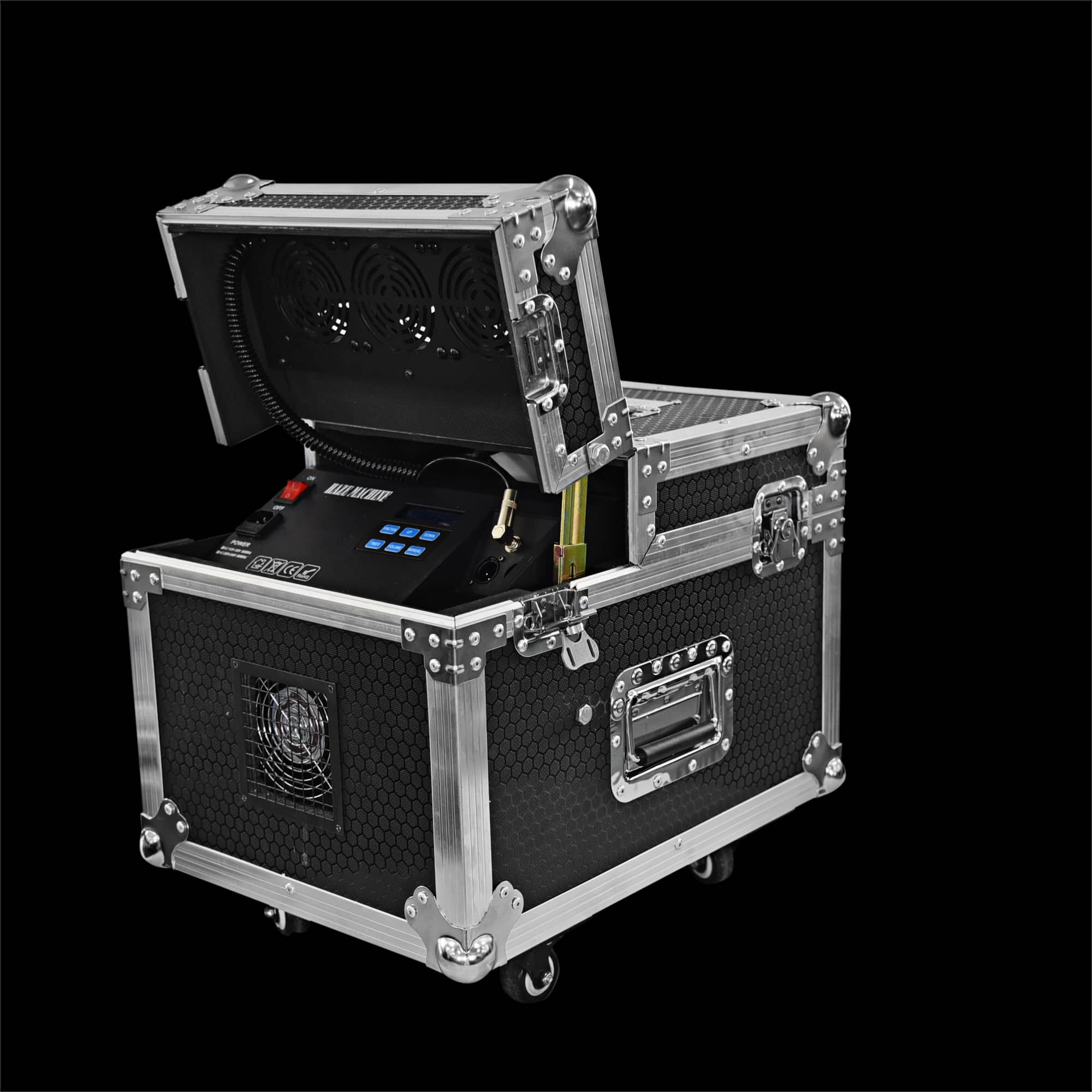
Market pricing in 2026 continues to segment by intended use: compact dual-heat units for rental houses and small theatres, mid-tier touring generators engineered for road resilience, and large integrated systems for arenas and film stages. Price ranges below reflect typical street prices and configured options (remote control, onboard reservoirs, flight-casing, and custom integrations). These bands should be validated with supplier quotes including warranty and spare parts terms before award.
| Class | Typical Power (kW) | Oil Capacity (L) | Warm-up Time (min) | Continuous Run (hrs at 50% duty) | Control Options | Approx. Price (USD) |
|---|---|---|---|---|---|---|
| Compact dual-heat unit (rental/small theatres) | 1.2–2.5 | 1–3 | 3–8 | 2–6 | DMX, wireless remote | $1,200–$3,500 |
| Pro touring generator (roadworthy) | 2.5–5.0 | 3–10 | 5–12 | 6–20 | DMX/RDM, Ethernet, queued presets | $3,500–$10,000 |
| Integrated venue/film system (high-capacity) | 5.0–15.0+ | 10–100 (tank or plumbed) | 8–20 | 12–72 (with plumbed feed) | Networked control, redundancy, central monitoring | $10,000–$60,000+ |
Warranty, field service, and spare-parts logistics
For enterprise buyers, warranty terms, local field-service capacity, and spare-parts logistics determine true readiness. Multi-year warranties and authorized service centers reduce downtime. Buyers should require guaranteed spare-parts availability in contract terms (e.g., critical spares within 72 hours) and consider factory-maintained service agreements for touring fleets.
Matching device class to production type
Selection logic: compact units for community theatres and small clubs, touring-grade generators for concert and festival circuits where transport vibration and rapid setup/teardown are factors, and integrated systems for residencies and film stages requiring plumbed tanks and central control. Match the device duty cycle and service model to the booking density and geographic footprint of operations.
Siterui SFX: manufacturing strength, customization, and product ecosystem
R&D, production, and quality control capabilities
As a professional manufacturer engaged in research and development, production, sales, and service of stage special effects equipment, we deliver engineered fog systems that prioritize heat management, atomization efficiency, and serviceability. Our engineering team applies thermal CFD modeling and accelerated life testing to validate heater longevity and droplet-size stability under typical venue HVAC conditions. Buyers can request test data, certification evidence, and sample run sheets during tender evaluation.
Flexible customization and integration services
We understand every venue and creative concept is unique. Our team provides customization options such as proprietary casing, logo printing, tailored reservoir sizes, wireless control stacks, and synced multi-device deployments for timed cues. For complex deployments, we offer turnkey integration including networked control, DMX/RDM mapping, and preconfigured show presets to shorten integration time during rehearsals and load‑ins.
Complementary product range and after-sales support
To provide full-stage solutions, Siterui SFX offers an ecosystem of effects including spark machines, haze machines, CO₂ jet units, bubble and snow systems, foam and confetti machines, conventional fog devices, flame-effect units, and dry-ice generators. Our global support network and spare-parts provisioning are designed to meet touring schedules and venue maintenance windows. For procurement teams, we provide BOMs, MTTR estimates, and logistics coordination to streamline fleet management.
Procurement checklist for enterprise buyers
Specification and tender must-haves
Require full technical data sheets, measured output curves at multiple ambient temperatures, MSDS for recommended fluids, electrical certificates (CE/UL/ETL), and a documented maintenance plan. Include evaluation criteria for mean time between failures, on-site service SLA, and spare-parts availability in RFQs to make objective supplier comparisons.
Operational readiness and commissioning
Plan commissioning with a pre-show run at venue environmental conditions and obtain written acceptance based on performance thresholds (e.g., coverage uniformity, reset time between cues). Ensure the supplier provides training for in-house technicians and a digital spare-parts list to maintain uptime across event cycles.
Lifecycle and upgrade path
Buyers should assess upgrade paths—modular heating elements, firmware updates for control, and retrofit kits for network connectivity—to protect procurement value over a 5–10 year lifecycle. Ask suppliers to include end-of-life recycling or return programs for electrical and heating components.
Frequently Asked Questions
What operational advantages do twin-heater oil fog generators offer over single-element models?
Dual-heating systems provide improved temperature stability under load, finer atomization for viscous fluids, faster recovery after sustained use, and redundancy that reduces the risk of complete unit failure—benefits that translate to reduced oil consumption and higher run-time reliability for demanding schedules.
How should venues validate fluid compatibility before large-scale deployment?
Request MSDS and compatibility matrices from the supplier, run bench tests for residue and droplet distribution, perform a short burn-in at venue ambient conditions, and verify no adverse effects on lighting lenses, projection screens, or scenic finishes before approval for performances.
What regulatory documentation must be provided during procurement?
Ask for electrical conformity certificates (CE/UL/ETL), MSDS for recommended fluids, documented test reports for aerosol particle size where available, and any local fire department approvals required by the venue. Also reference occupational safety guidelines from relevant agencies during risk assessments.
How do life-cycle costs compare between lower-cost units and High Quality touring models?
Lower-cost units have lower initial capital outlay but usually higher oil consumption, more frequent maintenance, and shorter MTBF. High Quality touring models have higher upfront price but typically lower total cost of ownership due to improved thermal efficiency, modular repairability, and better spare-parts support.
What control and integration features are essential for modern productions?
Essential features include DMX/RDM support, networked control (Ethernet or ART-Net), programmable presets, remote monitoring/diagnostics, and secure firmware update paths. For multi-device setups, synchronization options and centralized monitoring are critical for consistent cues and safety oversight.
Contact Siterui SFX to request detailed datasheets, fleet pricing, customization options, or to arrange factory acceptance testing: https://www.siteruisfx.com/ or email sales01@strlighting.com.

Email: sales01@strlighting.com
WhatsApp: +86 189 2232 4800
© 2025 Siterui SFX All Rights Reserved.
 Scan QR Code
Whatsapp: +8618922324800
siteruisfx_stage_equipment
Siterui
SITERUI-SFX
STRlighting
@siterui.sfx