
how long does haze from a haze machine last? | Insights by Siterui SFX
1. How long does haze from a water-based haze machine last in a 5,000 ft³ venue with HVAC at 6 ACH?
Short answer: visible haze density will decay rapidly — typically dropping by half in ~7 minutes — but residual haze may remain detectable for longer. Use the exponential decay model driven by air changes per hour (ACH) to estimate haze dissipation: C(t) = C0 × e^(−ACH×t/60). The half-life t½ = 0.693×60/ACH.
Calculation example: 5,000 ft³ (about 142 m³) with HVAC exchanging 6 ACH → t½ ≈ 0.693×60/6 ≈ 6.93 minutes. If you create a medium haze level (C0) with a short burst, after ~7 minutes it will look roughly half as dense; after ~21 minutes (~3 half-lives) it will be ~12.5% of the initial density and likely barely visible on stage lights.
Notes: water-based haze fluids (glycol/water or glycerin/water mixes) produce particles commonly in the ~0.3–2 μm range and behave like fine aerosols. Manufacturer technical sheets (typical for professional hazers) confirm these particle sizes, which respond quickly to ventilation. For planning, assume 5–25 minutes of useful visibility in spaces with 3–8 ACH unless you reintroduce haze.
2. How long will oil-based haze remain when the HVAC runs continuously at low speed (2 ACH) during a two-hour show?
Oil-based haze (mineral-oil fluids) tends to produce slightly larger and sometimes longer-persisting particles compared with water/glycol hazes. With low ventilation (2 ACH) decay is slower: t½ ≈ 0.693×60/2 ≈ 20.8 minutes.
Practical outcome: a single heavy burst can give you 30–90 minutes of noticeable haze in low-ventilation conditions, but the perceived persistence depends on occupant perception, stage lighting, and where the haze concentrates. Because oil-based particles can be more visible on surfaces as residue over prolonged use, many venues prefer water-based haze for higher session use.
Risk and maintenance: continuous oil-based haze in low-ventilation venues elevates the chance of surface buildup and can upset smoke detector sensitivity over repeated shows. Vendors often recommend limiting continuous high-density output and scheduling routine cleaning.
3. After a continuous 10-minute burst from a professional hazer, how long until particulate levels fall below common smoke detector thresholds?
Direct thresholds for smoke detectors are device-specific and influenced by detector type (ionization, photoelectric, beam, aspirating). Typical photoelectric detectors trigger on increased light scattering from particles; there is no universal ppm value you can rely on without testing. However, practical controls help avoid nuisance alarms.
Best practices:
- Run a short, lower-density burst and allow 1–2 HVAC air changes before increasing density if detectors are present; use the ACH decay model to estimate time to reduce concentration.
- Coordinate with venue/local fire authorities and notify monitoring services and staff; many venues temporarily isolate or adjust sensitive detectors during performances following NFPA 72 guidance and local code.
- Use theatrical detector logic: beam detectors, beam with higher thresholds, or aspirating systems with masking strategies where code permits. Always follow the detector manufacturer and AHJ (authority having jurisdiction) guidance.
Example: In a space with 4 ACH, a 10-minute burst will reduce by ~50% every 10.4 minutes. If the initial spike approaches a detector threshold, expect 10–30 minutes for a significant drop, depending on the threshold; test beforehand to set safe operating curves.
4. How does room humidity affect haze dissipation time for glycol-based hazes during outdoor summer events?
Humidity alters particle behavior: glycol- and glycerin-based hazes are hygroscopic to varying degrees — in high relative humidity (RH > 60%) the particles absorb water, grow in diameter, scatter more light (making haze look denser), and can settle or fall more slowly due to coagulation. In dry air (RH < 30%), particles stay smaller and often clear faster due to increased evaporation of the carrier (water) and more efficient dilution by air movement.
Practical guidance for outdoor summer events:
- High RH (e.g., coastal or after rain): expect longer perceived haze retention and brighter beam definition; plan shorter bursts and more frequent cycling to avoid over-saturation.
- Low RH with sun and wind: haze dissipates faster; you may need higher output or more units to sustain visible beams.
- Wind matters more outdoors than humidity — crosswinds or breezes rapidly dilute and disperse haze regardless of RH.
Recommendation: test on-site under representative humidity and wind conditions and document the haze dissipation timeline for your specific haze fluid and machine model.
5. What is the expected haze retention time when using multiple low-output hazers (DMX-controlled) versus a single high-output unit in a 20×40×12 ft theater?
Room volume ≈ 9,600 ft³ (272 m³). For a given ACH, particle decay is the same mathematically, but dispersion and perceptual uniformity change with distribution strategy.
Multiple low-output hazers advantages:
- More uniform haze distribution and fewer hotspots, so perceived haze density is consistent across the stage and audience.
- Lower local peaks reduce the risk of triggering detectors and lower visible residue on surfaces.
- Easier DMX control for micro-bursts and maintenance of a steady medium density with timed cycling (e.g., 6–15 second bursts on each unit every 6–12 minutes depending on ACH).
Single high-output unit advantages: quick fill and fast beam definition, but uneven coverage and higher local concentration near the unit, which can make local dissipation and residue management worse.
Retention time: mathematically identical overall (governed by ACH), but the multi-hazer approach yields a perceptual longer-lasting uniform haze at lower output settings and generally allows lower overall output to achieve the same visual effect.
6. How often should I haze (cycle) and at what intervals to maintain a consistent medium-density haze for a 3-hour performance without exceeding recommended exposure or overloading HVAC?
There is no one-size-fits-all interval; use ACH, desired visual density, and manufacturer exposure guidance to set cycles. A practical, tested regimen:
- Determine your baseline: run a short test burst and measure visible decay using the ACH formula and human observer checkpoints.
- Typical cycling strategy: 6–20 second bursts across distributed hazers every 8–20 minutes in rooms with moderate ventilation (3–8 ACH). Faster ventilation requires shorter cycles but more frequency.
- Measure and limit cumulative exposure by using the lowest effective density — many theaters maintain a medium haze with total on-time under 10–20% over a performance (e.g., for a 3-hour show, target total hazing runtime of 18–36 minutes spread across cycles).
Monitoring: use a handheld particulate meter (PM2.5) or consult venue environmental health guidelines. Check manufacturer MSDS and recommended exposure guidance; when in doubt, keep density as low as performance needs and coordinate with HVAC to temporally reduce exhaust during critical lighting cues if safe and allowed.
Additional buyer-focused technical notes (safety, maintenance, and selection tips)
- Particle size & environmental behavior: professional hazers produce submicron to a few micron particles; these are efficient at lighting beam shaping but respond quickly to ventilation. Check vendor tech sheets for particle size ranges when evaluating machines.
- Fluid choice: water-based (glycol/glycerin) is preferred for frequent use and lower residue; oil-based may persist longer but can leave film. Confirm compatibility between machine and fluid; using wrong fluids voids warranties.
- Controls: DMX/RDM or timer-based control gives precise short bursts, reducing overall fluid consumption and keeping haze duration predictable.
- Fire and detector policy: consult NFPA 72 and your AHJ; pre-testing and detector notification are mandatory in many venues. Use theatrical-approved sensor management strategies only where code permits.
- Maintenance: purge lines daily, use manufacturer cleaning fluids weekly for heavy use, and replace wicks/filters per service schedule to preserve output consistency and extend machine life.
Concluding summary: Advantages of using professional haze machines include consistent, controllable beam definition with lower momentary density than fog, better uniformity when using distributed low-output units, and reduced risk of nuisance alarms when operated with ACH-aware cycling and detector coordination. Proper selection of haze fluid, DMX control, and routine maintenance maximizes performance while minimizing residue and health risks.
For a tailored equipment quote and on-site testing plan, contact us for a quote at www.siteruisfx.com or email sales01@strlighting.com.
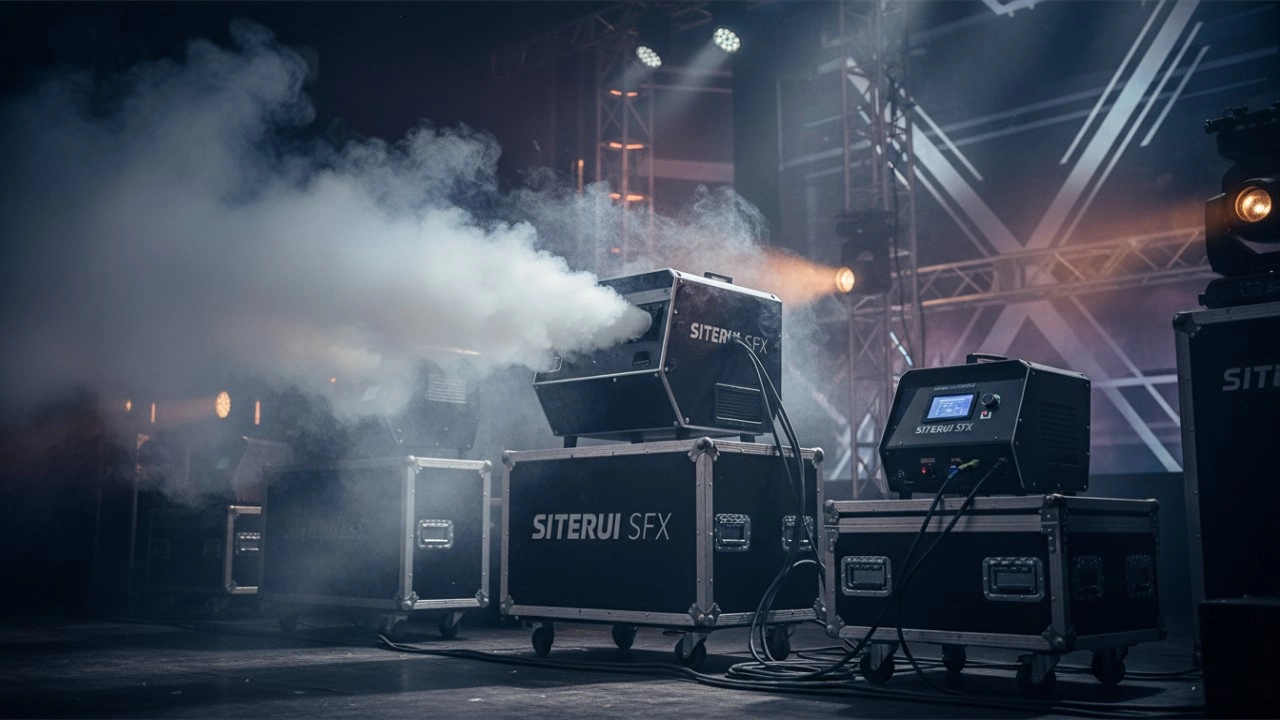
Comparing Professional Fog and Haze Machines for Stage Lighting in 2026
High-Impact CO2 Jet Systems for Electronic Dance Music Festivals in 2026
Advancements in Cold Spark Machine Technology for Indoor Events
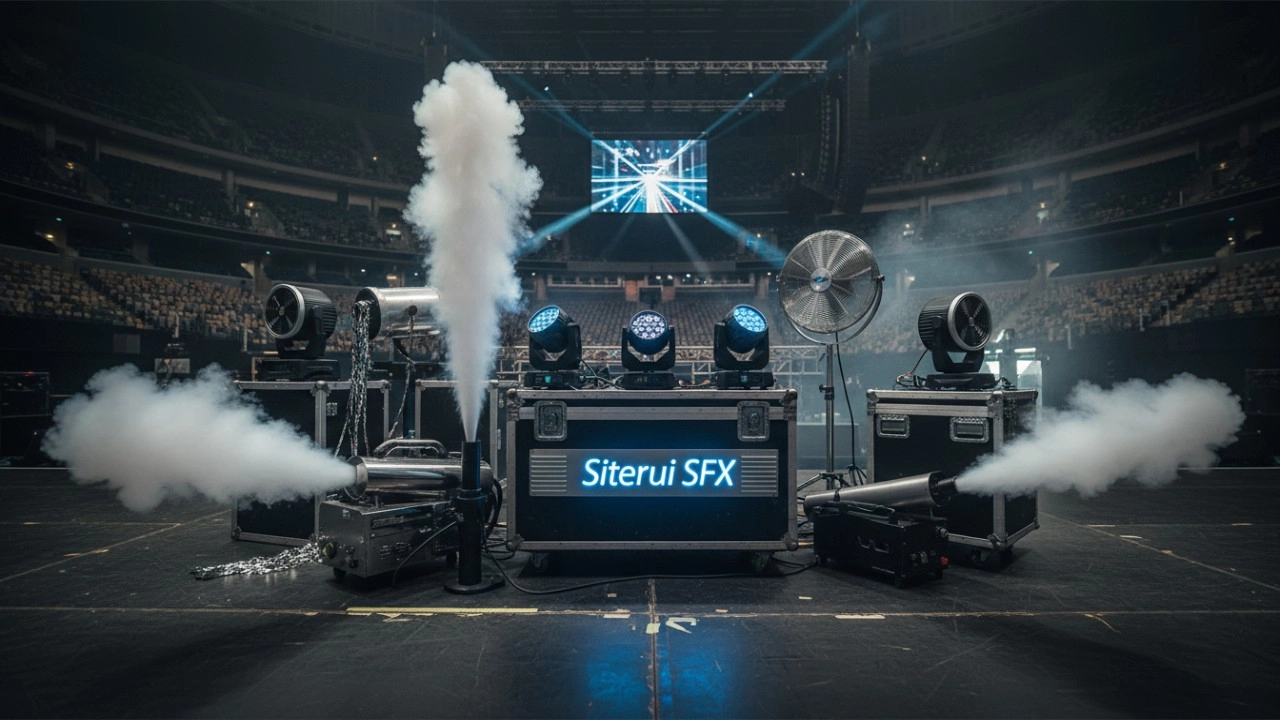
Exploring Core Categories of Professional Stage Special Effects (SFX) Equipment
Recommended for you


Stay Informed or Connect with Us
Have questions about our latest news or updates?
Reach out to us—we're here to provide more insights or media support.
Email: sales01@strlighting.com
WhatsApp: +86 189 2232 4800
© 2025 Siterui SFX All Rights Reserved.
 Scan QR Code
Whatsapp: +8618922324800
siteruisfx_stage_equipment
Siterui
SITERUI-SFX
STRlighting
@siterui.sfx