
how much titanium powder does a cold spark machine use per minute? | Insights by Siterui SFX
1) Exactly how many grams of titanium-based powder will a cold spark machine use per minute during continuous output?
Short answer: it depends — but typical ranges from manufacturer datasheets and field tests are roughly 2–15 g/min. Low-power units or finely tuned ambient effects often run 2–5 g/min; mid-range systems commonly consume 5–8 g/min; high-output festival-grade machines under full continuous output can use 8–15 g/min or more. These values describe cold spark powder consumption (often titanium‑based or proprietary alloy powders) expressed as grams per minute.
Why such a wide range? Powder consumption (grams/minute) is controlled by four major variables: machine model and motor/feed mechanism, nozzle size and air/atomization settings, selected visual intensity (duty cycle, pulse length), and the powder formulation/particle size. Manufacturer technical sheets usually quote a 'typical consumption' number for a standard nozzle and continuous mode — use those as a baseline, then validate on-site.
Practical tip: treat published consumption as an estimate; always run a calibrated test (see Q2) under the same pattern and ambient conditions you will use for the show.
2) How can I accurately measure powder consumption (grams per minute) for my cold spark machine on-site?
Use a repeatable, instrumented method. Steps:
- Weigh the hopper/powder container on a calibrated scale (precision ±0.1 g) before the test.
- Run the exact show pattern you plan (continuous or pulsed) for a fixed, timed interval (e.g., 60 seconds or 3 × 20s bursts with specified pauses).
- Weigh the hopper immediately after the run; calculate net powder used. Divide by the run time to get grams/minute.
- Repeat at least three times and average to reduce variability (feed jams, humidity). Record ambient temperature and relative humidity — moisture will affect flowability and apparent consumption.
Example: initial weight 1020.0 g; after 60s continuous run weight 1015.2 g → consumption = 4.8 g/min. If you run pulses (e.g., 10s on / 10s off) repeat the test with the actual duty cycle to determine effective grams/min during active firing versus average grams/min for the entire cue.
Document the feed-rate setting, nozzle size, and powder batch code — powder granulation and formulation change consumption even on the same machine.
3) How do powder particle size, composition and humidity change grams-per-minute consumption and the spark look?
Powder physical properties are crucial. Particle size distribution (PSD) and shape affect flowability, volumetric feed accuracy and how particles atomize in the air stream — which in turn changes both consumption (g/min) at a given feed motor setting and the perceived brightness and tail length of the spark.
- Smaller/very fine particles: better atomization and brighter instantaneous effect, but higher surface area increases combustibility and can pass through sieves causing more frequent nozzle wear or choking; feed motors may need lower settings, so grams/min for the same visual may be lower or higher depending on design.
- Larger/coarser granules: may require higher feed settings to achieve the same visual mass of sparks; they can increase grams/min consumption but also create chunkier sparks and different fall patterns.
- Powder composition: 'titanium-based' powders marketed for cold sparks are engineered to control ignition temperature, color and safety. Substituting unsupported metal powders changes the heat release and effective visual output for the same grams/min.
- Humidity and storage: moisture causes clumping and inconsistent flow; effective grams/min will drop if powder bridges in the hopper or if the feeder slips. Store in dry, climate-controlled conditions and use desiccant packs for long-term storage.
Best practice: use manufacturer-approved powder batches and request PSD/technical datasheets if you need to optimize feed settings for grams/min consumption versus visual effect.
4) How do I calculate how much powder (kg) to order for a tour with X shows and Y minutes per show?
Use a simple calculation: total powder (g) = consumption_rate (g/min) × active_minutes_per_show × shows × contingency_factor.
Example calculation with conservative assumptions:
- Consumption_rate (measured or manufacturer's mid point) = 6 g/min
- Active_minutes_per_show (total minutes of active firing across cues) = 5 minutes
- Shows = 30 shows
- Contingency_factor = 1.25 (25% spare for rejects, testing, humidity losses)
Total = 6 × 5 × 30 × 1.25 = 1,125 g → order 1.2 kg (round up to next available pack). If you want a safety buffer or different feed patterns are used, increase contingency to 1.4–1.5. For large festivals consider a higher contingency because higher-output settings often increase grams/min non-linearly.
Logistics note: powders are supplied in sealed, labeled packages. Keep batch codes and certificates of conformity for each shipment to meet local safety and insurance requirements.
5) Can I substitute generic titanium powder for the machine's recommended spark powder — and how will that affect grams-per-minute and safety?
Do not substitute generic metal powders without explicit manufacturer approval. Reasons:
- Flow mechanics: generic powders may not match the particle size, shape, or flow additives used in approved spark powders, causing erratic feed and either under- or over-consumption (changing grams/min unpredictably).
- Combustion properties: proprietary powders are engineered to burn at temperatures safe for 'cold spark' designation and produce the desired visual. Using raw titanium, aluminum or other metal powders can produce hotter sparks, increased slag, or different colors, increasing safety and liability risks.
- Equipment wear and clogging: improper particle size increases abrasion on feed screws and nozzles leading to drift in grams/min and higher maintenance costs.
- Regulatory and insurance: most manufacturers require approved powders to maintain warranty and compliance; using unapproved powders can void warranties and violate venue/fire code rules.
Recommendation: buy manufacturer-approved cold spark powder (titanium-based formulations if specified) and retain SDS paperwork. If you must test a different powder, perform small controlled tests, measure grams/min, and get written manufacturer consent.
6) How can I optimize machine settings (feed rate, nozzle, air) to reduce powder usage while keeping the same visual impact?
Optimizing means improving spark efficiency (visual per gram). Steps to reduce grams/min without losing effect:
- Use the correct nozzle: smaller, well-maintained nozzles can concentrate the spray and make sparks appear denser for less powder. But smaller nozzles can clog — balance is required.
- Adjust feed timing: use pulsed bursts instead of long continuous jets. Short, well-timed bursts often look brighter than the same powder used continuously because human perception favors peaks. Measure grams consumed per cue to compare.
- Tune air/atomization: proper air pressure and patterning reduce powder waste and improve particle combustion efficiency. Too much air disperses powder and increases grams/min for the same brightness.
- Use optics and lighting: augment sparks with stage lighting or haze to increase perceived volume so you can lower grams/min while maintaining impact.
- Maintain equipment: worn feeders and nozzles require higher feed rates to achieve the same spark density — regular maintenance reduces consumption.
Trade-offs: aggressive powder reduction can change spark color, height and hang-time. Always document settings (nozzle ID, feed motor % or rpm, air PSI) that achieve lower grams/min so you can reproduce them on tour.
Conclusion: Cold spark machines deliver dramatic, low-residue sparks suitable for indoor use when supplied with approved titanium-based or proprietary spark powders. Typical powder consumption ranges from about 2–15 g/min depending on machine power, nozzle, powder particle size and duty cycle. Accurate grams-per-minute figures require on-site measurement with a calibrated scale and repeat testing. Optimizing nozzle size, feed timing and air atomization — and using manufacturer-approved powders — reliably reduces powder usage without compromising visual quality.
Advantages summary: Cold spark effects provide indoor-capable, low-fallout visuals with predictable powder consumption when you follow manufacturer powder specs, measure grams/min on-site, and optimize machine settings. They offer lower risk and simpler logistics than pyrotechnic alternatives, plus easier regulatory clearance at many venues when using approved powders and equipment.
Contact us for a quote or technical support: www.siteruisfx.com — sales01@strlighting.com
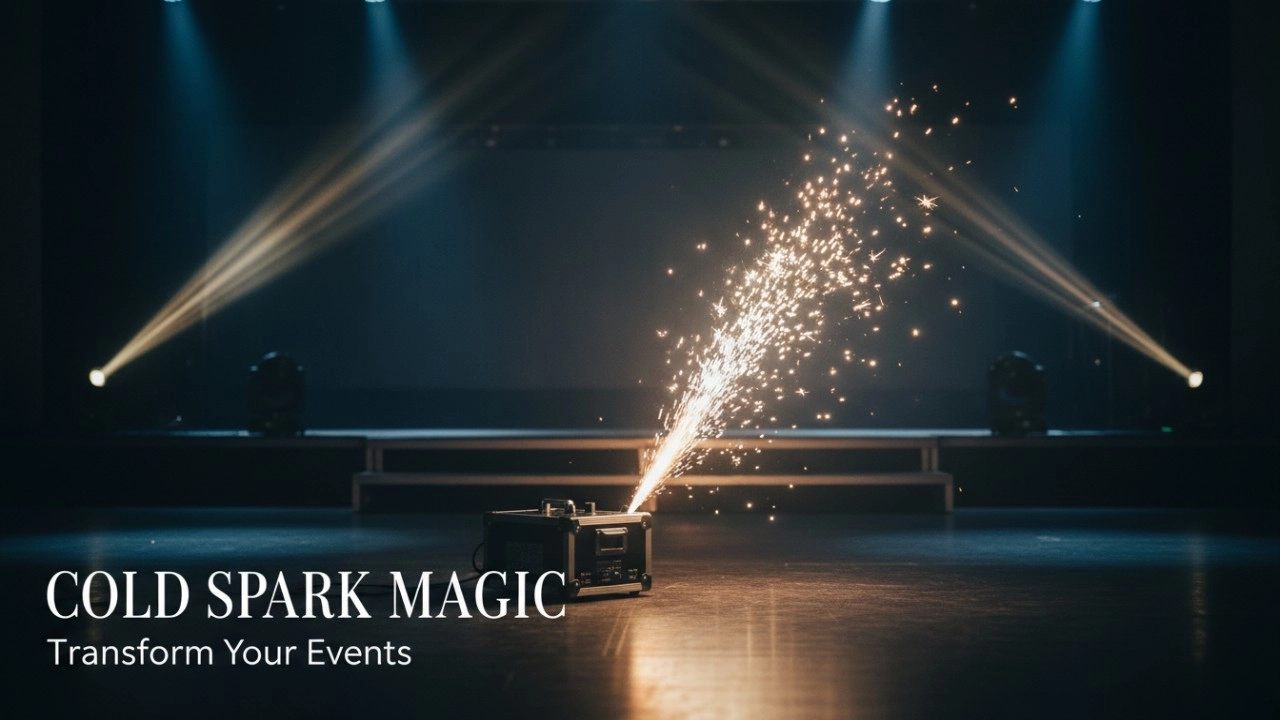
Top 10 Cold Spark Machines for 2026: A Deep Dive into Performance, Powder Life, and Durability
How to Choose a Snow Machine: The Definitive Checklist to Avoid Costly Mistakes (2026 Guide)
Fog Machines Explained: Technology, Control Systems, and Modern Stage Applications
Haze Machines Explained: The Definitive 2026+ Guide to Effects, Selection & Future Innovations
Recommended for you


Stay Informed or Connect with Us
Have questions about our latest news or updates?
Reach out to us—we're here to provide more insights or media support.
Email: sales01@strlighting.com
WhatsApp: +86 189 2232 4800
© 2025 Siterui SFX All Rights Reserved.
 Scan QR Code
Whatsapp: +8618922324800
siteruisfx_stage_equipment
Siterui
SITERUI-SFX
STRlighting
@siterui.sfx